
I built Aristotle a philosophy school. Then I changed how it worked.
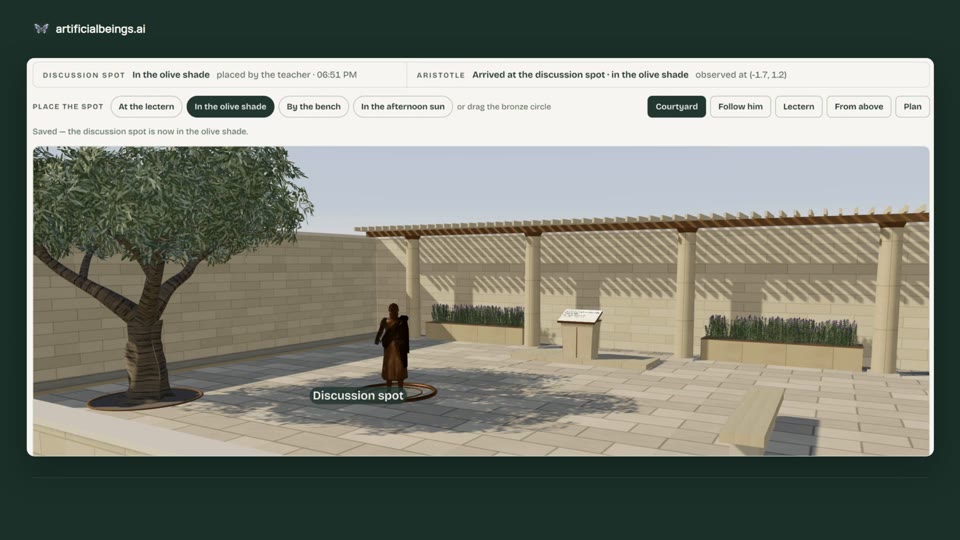
Our meeting spot in the courtyard.
On my screen, the philosophy school has two sides. On the left is a tiled courtyard with an olive tree. On the right is today’s workshop plan, where a student named Sophia has the opening question: Should you tell a friend their cake tastes terrible?
Aristotle is standing in the courtyard, ready to walk over to the tree and introduce her. Of all the ways this school could have turned out, spending an afternoon on how to handle a friend’s bad baking is pretty close to what I had in mind.
Aristotle was always going to be my first agent. That was a promise I’d made to myself. Bringing him back to life in a fuller way is the bigger hope, and I’m still a long way from pulling that off. A school gave me a practical place to start, once I figured out what the two of us would actually do there.
When people put a famous philosopher into software, the obvious move is to wire him up to a chat box and ask a big question about virtue. Do that, though, and he gives you four paragraphs of lecture notes before you close the tab. What I actually like about a philosophy workshop is that a good answer from one person often sparks a much sharper question from somebody else across the table.
To get that kind of conversation, it made sense to put more people in the picture. The students could bring the questions, I’d lead the class, and Aristotle could act as my teaching assistant—keeping track of the room and the lesson plan so I didn't have to.
My first request in Artificial Beings went roughly like this:
Make Aristotle a warm, playful helper for my philosophy workshops. I’ll lead the class. Help me keep track of the students, the questions they bring, and what we plan to discuss.
From that description, the platform built a working workspace for the school. Putting Aristotle in charge of the clipboard left me free to follow an answer somewhere unexpected. Say someone mentions in passing that it matters who else is at the table when you taste the cake. That’s the person you want to keep talking to. It is nice to have Aristotle looking after the plan while you find out what they mean.
What belongs on today’s agenda?
“Keep track of the questions” sounds straightforward until the first question comes in.
When a student submits a question, should it go straight onto today’s agenda? At first, that looks convenient. It gives the workshop a running order without much effort on my part—provided we want to discuss the nature of justice and a dry cake in whatever random order people happened to think of them.
The moment that made the real problem obvious to me is the question that comes up with two minutes of class left. Somebody stays quiet for nearly an hour, then asks something with a whole afternoon inside it right as people reach for their coats. You could ask the student to bring it up again next week, but then the one person who already took the trouble to put a tricky thought into plain words has to remember those exact words seven days later.
So I changed the school to separate collecting questions from planning a class.
First, the academy got a question collection where every incoming question lands and stays. Second, it got today’s agenda. Planning a workshop meant browsing that collection, picking a few questions that fit well together, and putting them in order for the day. Each entry kept the name of the student who brought it. Weeks later, it could still sit on the list as Sophia’s question about the cake. A note to myself saying “honesty” would give me considerably less to go on.
Splitting those two jobs also cleared up what belonged on the opening screen. The evening before class is for browsing through everything students have asked. A minute before class, with that work already done, you don't want to stare at a backlog; you just want today’s plan. Opening the academy now brings up the next session right at the top: where and when we’re meeting, and the question that will get us started.
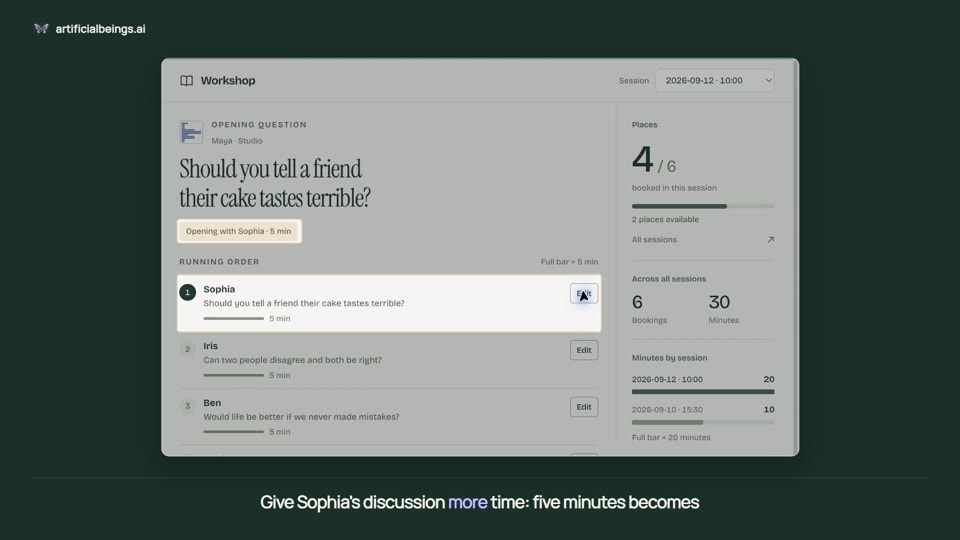
The time set aside for each question counts toward the workshop total.
There was also a place on the agenda to give each discussion a few minutes, with a chart beside the list adding them up toward the workshop total.
When I first put Sophia’s question on the agenda, I gave it five minutes. Five is an easy number to type in while setting up a plan, and a harder number to defend once I actually tried answering her myself.
My first thought was that of course you thank your friend for the cake. They made you something. Then I noticed Sophia hadn’t said why they made it. Were you sitting at their table for dinner, or had they called you into the kitchen to taste a recipe they were testing for a wedding? The exact same remark about dry cake is rude at dinner and the whole reason you were invited into the kitchen.
That split makes for a good opening in class. Two people can give opposite answers for sensible reasons, and it might take a few minutes before either of them realizes what room the other person pictured. Five minutes would only get us through a quick round of opinions. A few extra minutes would give Sophia a chance to let the disagreement play out and do something with the answers.
I opened her question on the agenda, changed the five to an eight, and saved it. The minutes chart beside the schedule picked up the extra three.
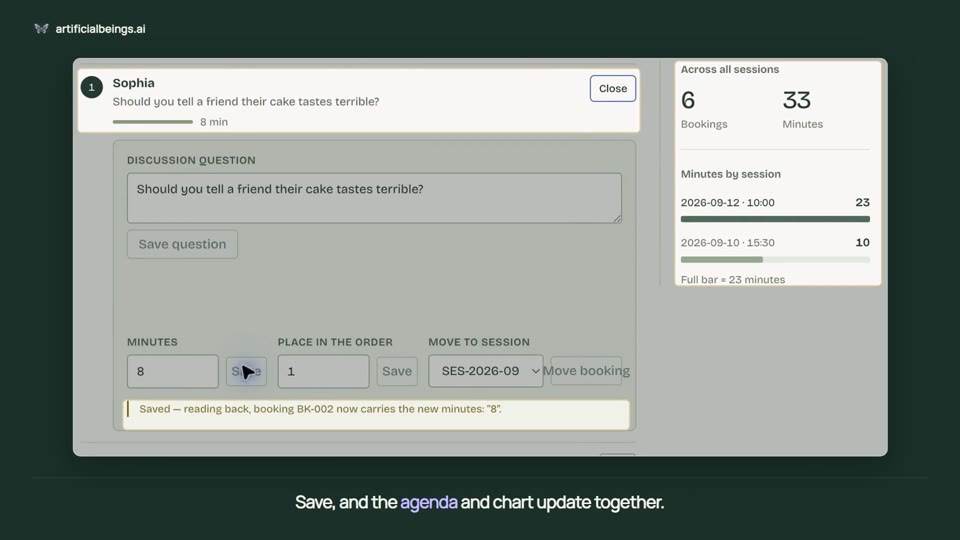
Sophia still goes first, with eight minutes for her discussion.
My short description had turned into a school I could actually use and change. Going in, “a warm, playful helper” was about as specific as my idea of Aristotle got. Now there was a real class to prepare for, and apparently I had an opinion about how many minutes to spend on dessert.
With the agenda settled, I turned back to the courtyard on the left side of the screen.
On an ordinary workshop plan, a meeting place is just a few words at the top of the page. Here, Aristotle could walk over to it. The patch of shade under the olive tree was easy to recognize and looked like somewhere you’d settle in for a conversation, so I set that as our discussion spot.
To start class, I typed a single line:
“Please introduce Sophia’s opening question from the discussion spot.”
Aristotle walked across the courtyard, stopped under the olive tree, and turned to Sophia. In the panel beside him, he welcomed everyone into the shade. Truth and friendship, he noted, usually get along fine until somebody pulls a bad cake out of the oven. After a few words about honesty and kindness, he invited Sophia to lead the discussion. She had eight minutes.
Watch Aristotle walk over and introduce Sophia in the courtyard.
What pleased me most was how little there was to explain to him by then. With an ordinary chat window, you have to copy and paste your notes every time you change your plan. Here, “Sophia’s opening question” was enough. Because the two of us were working from the same live agenda, he already knew who was speaking, where we were meeting, and the small change of mind I’d had before class.
Two films and one Friday night
Any group plan where you collect ideas over time and pick one for tonight works the same way. A movie club is a good place to try it for yourself. Most clubs have more films they’d like to see than evenings to watch them, and often the best reason to pick a particular film is the friend who suggested it. If someone has spent months telling everybody to watch Alien, you want them there on the night.
Make me a movie-club helper for our monthly screening. Keep track of the films people suggest and who suggested each one. When I open the club, show me what we’re watching next. Let me pick the film and change the selection while keeping the other suggestions.
Pick Alien for Friday. Then suppose Thursday arrives and that’s the one evening your friend can’t come. Swap Alien for The Iron Giant and open the club again. Friday’s selection updates to The Iron Giant, with Alien still waiting on the list beside the name of the person you’re saving it for.
For a project of your own, you can borrow the bones of that request:
Make me a [character or helper] for [a moment when I’d use it]. Help me [do a specific job] and keep track of [what I’ll want to remember]. When I open it, show me [what I need to see first]. I’ll choose [what happens next]. Let me change [a decision I might revisit].
Describe your idea in Artificial Beings.
0 comments
No comments yet. Start the conversation.