
Your feeder camera caught two cardinals. How many count for FeederWatch?
At 8:17 the two Northern Cardinals finally fit in one frame. The male has a sunflower hull hanging from his bill. The female tilts her head as if she’d like to tell him about it. You know which picture your sister will want.
Your feeder camera caught the whole thing. You were downstairs moving the laundry.
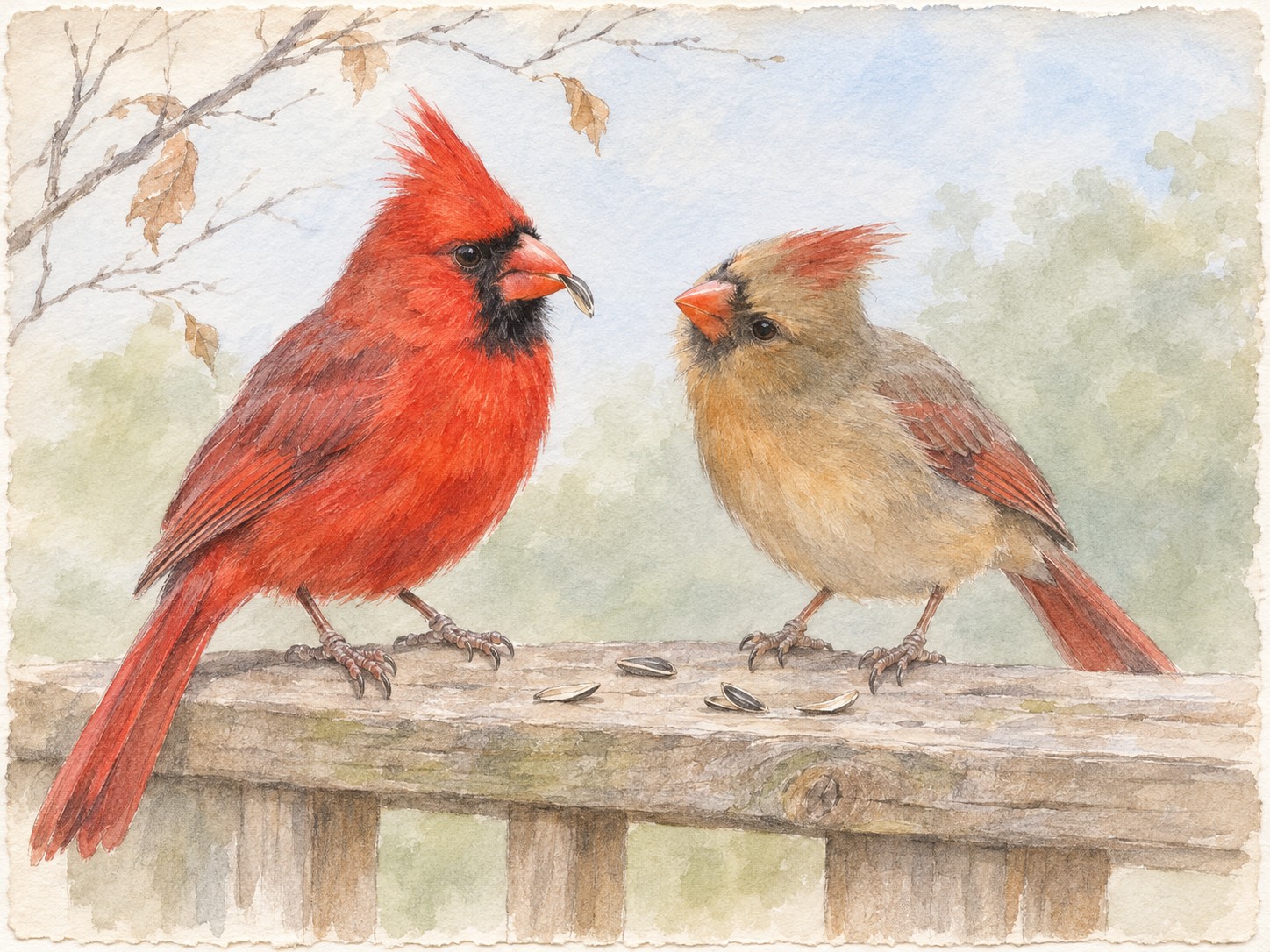
This November morning is invented. The drawing is an AI illustration of the 8:17 clip. You’re the only person watching this patch of yard. Leave space on a scrap of paper for your Project FeederWatch tally and a line for the back of a postcard.
Three visits to the rail
8:05 a.m. From the kitchen window you see the red male on the rail. He cracks a seed and flies off.
8:17 a.m. The camera saves the pair together while you’re downstairs. Later you open the clip and see that ridiculous hull.
8:33 a.m. You’re back at the window. The female is there, alone this time. She wipes her bill on the rail and goes.
Before reading on, write down the most Northern Cardinals you saw together while you were at the window. Then give the postcard a line your sister would want to read.
My postcard would say, “Would you tell him, or let him wear his breakfast?” I’d send the 8:17 picture and pencil 1 Northern Cardinal on the tally. At each of my two turns at the window, one cardinal was in view.
What would make you rub out the 1?
Leave the clip exactly as it is. Change the last moment. The female is still wiping her bill when you see the male land in the lilac beside her. Both birds are in your count site and you can see them together from your chair. Now write 2. Your sister gets to keep the same postcard.
Project FeederWatch asks observers to record the largest number of each species they see at one time during a two-day count. The project leaves camera-only sightings out of that tally. Cornell and Birds Canada give the male and female cardinal as an example. Although you can tell them apart, the same counting method has to work for a flock of look-alike chickadees. Project FeederWatch’s counting instructions · The project’s explanation
Stella Tea, a first-time FeederWatcher, wrote about this distinction in the Montgomery Bird Club newsletter. Her trail cameras had often picked up coyotes. One December count day she finally saw one herself. She photographed it and recorded how much she loved the moment. I’d want room for that sentence in a bird notebook, too. Stella’s story, page 7
Leave a line for tomorrow
On your next watch, try writing down the moment that earned the number. “Both in view, one on the rail and one in the lilac” is something you can picture when you come back the next morning. Beside it, keep one detail you’d like to tell somebody. Sometimes that will be the same moment.
For a notebook you can change, open the editable bird notebook. Try changing who was at the window at 8:17, then ask which observation supports the count. You can play the whole exercise on paper. Building the agent takes Make at $25 a month. Here’s the starter you can copy.
Make a family bird notebook I can rehearse with invented observations at one kitchen window. Give me a postcard album and a practice tally for a two-day Project FeederWatch count. In each entry keep the time, species, number together and whether I saw them myself or opened a camera clip later. At 8:05 I saw one male Northern Cardinal. At 8:17 the camera alone recorded a male and female together. At 8:33 I saw one female. Let me choose a postcard and write its caption. For each species keep the highest number I personally saw at one time from my window during the count. Show which observation supports that number. Let me change the last entry so I saw both together and see what changes. Keep my camera memories in the album. Let me write the next morning myself. Leave any real survey submission to me.
0 comments
No comments yet. Start the conversation.